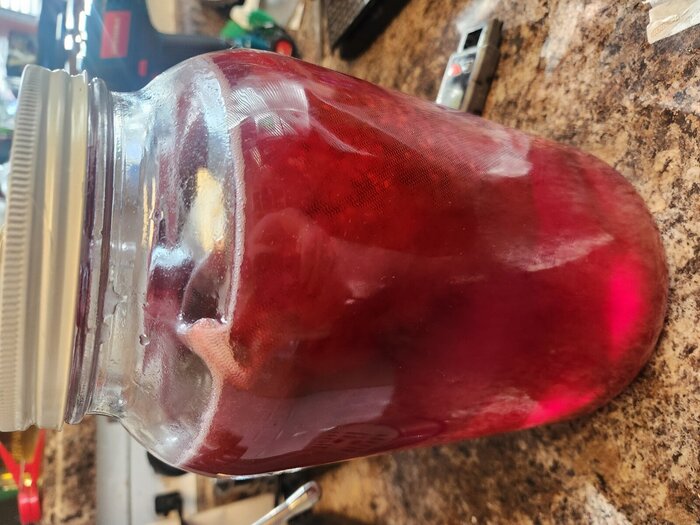
A delicious drink made of Texas ingredients! Flavor Profile: Smooth and sweet with floral notes, tart, fruity depths, and a nutty, toasted complexity with a crisp, clean terroir tying it all together.

Ingredients
3 lbs - Raw Texas Wildflower Honey (Get the Good Stuff!)
1 to 1.5 lbs - Fresh Blackberries (3x 6oz boxes)
1 to 1.5 lbs - Prickly Pear Fruit (about 4 fruits)
1-2 oz - Pecan Wood Chips
½ to ¾ gallon - Texas Spring Water (like Ozarka)
1 packet - Wine Yeast (Lalvin EC-1118)
1 tbsp - Sanitizer
½ + ½ tspn - Yeast Nutrient
1 - Small Mesh Bag to Hold Fruit
½ tspn - Pectic Enzyme
½ tspn - Bentonite Clay
½ tspn - Potassium Sorbate
¼ tspn - Potassium Metabisulfite
Procedures
Create Must
Sanitize Equipment
Add sanitizer to 1 gallon of water in container for mead and wait 60s
Pour into a bowl and let other equipment (air lock, stopper, grad cylinder, funnel, etc) also soak for 60s
Prepare Fruit
Scoop out prickly pear guts and put into mesh bag. Also add rinsed blackberries.
Smash the fruit inside the bag, catching any excess juice
Place fruit bag and juice into container for mead
Create Must
Pour the 3lbs honey into jar. You won't get it all out easily, and that's okay, it's accounted for. Plan for 2.5 lbs to get in there!
Fill the container with warm spring water until it's a gallon. Make sure to leave room for fermentation to bubble up (like an inch from top) even if that puts it a bit under a gallon.
Mix the honey completely into the water forming must. I recommend a sanitized spoon to stir it.
Add Pectic Enzyme
Dissolve the pectic enzyme in the must
Let the pectic enzyme work for at least 12 hours
Ferment
Pitch Yeast
As per instructions on the packet, mix yeast with hot water and stir for 20 min
Add the ½ tbspn yeast nutrient to the must and shake the container in a circle to mix
Add yeast to must and seal with an air tight lid (with airlock). Put it in a dark room at 65-75ºF (room temp).
Degass (Day 2)
Let sit for 24 hours then degass by opening the lid, shaking it in a circle thoroughly for 2 minutes to get rid of CO2
Return it to its fermentation area
Second Nutrient Addition (Day 5)
Degass again and slowly add the second dosing of yeast nutrient
If you don't go slow it may bubble out of control and make a mess! Add a bit, shake, add a bit, shake.
Return it to its fermentation area
Check Gravity (Day 20+)
Check to see if it's still bubbling. Check if the specific gravity is near 1.000.
If not, then periodically check after another week.
Wood Aging
Heat oven to 400ºF
Siphon the mead to a new (sanitized) container, leaving behind the solids
Toast the wood chips on a baking sheet in a single layer for about 25 minutes (don't let it burn though)
Soak the wood chips in boiling water for 10 minutes
Add the wood chips to the new container
Check the flavor after a week. If not quite there, wait another week. Then proceed to stabilization.
Stabilize and Bottle
Stabilize
Siphon the mead into the (resanitized) old container, leaving behind the wood chips
Slowly add the bentonite clay to ¼ cup boiling water. Stir continuously until the mixture becomes smooth with no clumps. Let it cool then mix into the mead.
Add the Potassium Sorbate to the mead and mix in
Wait 24 hrs (important!) then add the Potassium Metabisulfite
Wait 1-2 weeks for the mead to fully clear via the clay
Back Sweeten (Optional)
Add more honey to taste if you want it sweeter (increments of a tablespoon). You'll have to wait a bit again after stirring.
Bottle
Siphon into sanitized bottles
Aging (Optional)
Mead tastes best after aging for 3-6 months to develop more complex flavors
Comments
Enter the 6-digit code sent to your phone: